At the core of the attached video are some thirty photos of Mennonite refugees arriving from Moscow in 1929 which are new archival finds.
While some 13,000 had gathered in outskirts of Moscow, with
many more attempting the same journey, the Soviet Union only released 3,885
Mennonite "German farmers," together with 1,260 Lutherans, 468
Catholics, 51 Baptists, and 7 Adventists.
Some of new photographs are from the first group of 323
refugees who left Moscow on October 29, arriving in Kiel on November 3, 1929. A
second group of photos are from the so-called “Swinemünde group,” which left
Moscow only a day later. This group however could not be accommodated in the
first transport and departed from a different station on October 31. They were
however held up in Leningrad for one month as intense diplomatic negotiations
between the Soviet Union, Germany and also Canada took place. This second group
arrived at the Prussian sea port of Swinemünde on December 2.
In the next ten days, a further nine transports arrived from
Moscow to Germany by train via Riga, Latvia. In total 5,671 “Russian-German
farmers” to Germany from the USSR; about 3,885 were Mennonites. Those left
behind—by then as many as 9,000 Mennonites—were forcibly loaded into trucks,
taken to a railway station, and pushed into overcrowded freight cars typically
destined for exile settlement.
Of the Mennonites evacuated to Germany in 1929, only about 800 were cleared for immigration to Canada. MCC settled another 1,572 in
Paraguay, and 1,440 sailed for Brazil.
The high-stakes international drama behind the scenes in October and November 1929 is presented below to complement the video.
(A first group left in August—which sparked the large-scale flight to Moscow; see previous post).
October 11 (?): Official representative of Russian
Mennonites Benjamin H. Unruh submits petition to Germany’s Foreign Affairs
outlining the critical condition of the Moscow refugees and options for
assistance (note 1).
October 13 & 15: Foreign Affairs Counsel Carl Dienstmann
is dispatched to Moscow for diplomatic negotiations with Boris Shtein of the
People’s Commissariat for Foreign Affairs (note 2). Did not go well.
October 16: The Secretariat of the Central Committee of
Communist Party makes decision to forcibly return ethnic Germans gathered on
the outskirts of Moscow to places of origin.
October 17: A three-person “private” German delegation
interviews the German farmers in the suburban cottages of Moscow together with
reporters, to the great anger of Shtein.
October 18: With the foreign press ready to publish, a
compromise was reached between Germany and the Soviet Union, leading to a
Politburo decision signed by Stalin that read, “Do not object to emigration of
Mennonites gathered near Moscow” (note 3). Germany in turn communicated to
Canadian officials the news and offered to guarantee return for deferred,
“defective,” or deported immigrants.
October 26: USSR actively urges Germany “to accelerate the
departure of the colonists,” whom they now publicly deemed to be “class-hostile
elements,” starting with some 800 to 1000 persons out of Leningrad, followed
soon after by another 5,000 via train (note 4).
October 27: German Foreign Affairs is informed by Moscow
that a first group would depart on October 28; Unruh and Canadian officials
informed on 28th.
October 29: Unruh wires Bishop David Toews (Rosthern;
Canadian Mennonite Board of Colonization) to confirm the larger movement and
need for the Canadian Pacific Railway [CPR] to assume responsibility.
October 29: Before any response from Canada, a small first
group of 323 refugees was moved out rof Moscow to Leningrad, and on Oct. 31 for
Kiel, Germany where they arrive three days later (note 5). A second group is
departs Oct. 31 but is held up in Leningrad for one month
("Swineünde" group).
October 30: Toews responds: “Trying to arrange by wire with
[CPR; Colonel] Dennis and [Prime Minister] King movement of total group” (note
6). Germany approves movement with expectation that Canada would ultimately
accept refugees and the CPR take on costs.
October 30: Canadian gov’t tells Berlin it is not prepared
to accept refugees before the spring. The CPR refuses to take any financial
responsibility for the emigrants and costs; Germany immediately stops further
approvals (note 7).
November 2: Unruh wires Toews: “Moscow will send colonists
to Siberia if Ottawa refuses on Monday. Berlin requires a decision whether
despite possible refusal by Ottawa 6,000 should be brought to Hamburg. I
urgently request immediate direction before tomorrow” (note 8).
November 3: With arrival of Kiel group, the conservative
Berlin-based newspaper Vossische Zeitung prepared to tell full story of
catastrophic flight of thousands of “blonde, healthy farmers of German stock”
to embarrass Moscow and stir German emotions (note 9).
November 4: Chicago Tribune draws attention to the plight of
Mennonites, and to real possibility of a massive movement (note 10).
November 4: Unruh restarts negotiations with only vague
indications of financial support from North American, Dutch and German churches
to maintain refugees in Germany (note 11).
November 4: Toews deputation to meet with Prime Minister
King in Saskatchewan. Postponed. German Consul General Ludwig Kempff in
Montreal: “Toews wires that he will meet with the Prime Minister tomorrow (November
5); please obtain postponement in Moscow.” Unruh reports that delay “made
Berlin very anxious,” even if “Mr. King is very sympathetic to the Mennonites”
(note 12).
November 6: German Foreign Minister Julius Curtius reports
to Reich Chancellery that if USSR grants exit visas and Germany does not act,
thousands of these “farmers of German origin” in Moscow would be “shipped back
to Siberia … abandoned and exposed to certain destruction”—and on the “European
stage [Moscow] will ascribe blame for the fate of the people to us” (note 13).
Curtius inclined to make a hard break in German-Soviet relations if necessary (note
14).
November 6: PM King tells Toews' deputation that it is a
matter for Minister of Immigration and Colonization, Hon. Robert Forke, and
that the provinces concerned—Saskatchewan was first choice—would need to be
consulted (note 15). On King’s advice Toews left immediately for Ottawa to meet
with Forke, representatives of the CPR, and Kempff; wires Saskatchewan’s new
Conservative/Co-Operative Premier James Anderson.
November 6: Berlin press captures urgency of moment and
points blame squarely at Canada’s politicians and Mennonite organizers (note 16).
American MCC Executive members tracking news; they do not understand or feel
the urgency of crisis (note 17).
November 6: Stalin returns from his vacation and is briefed
on the entire matter; more extreme measures planned (note 18).
November 7: Chicago Tribune reports on the Kiel group and on
the urgency of the situation: “Due to the delay of the arrival of the Canadian
visas, soviet authorities have threatened to deport the remaining Mennonites to
Siberia” (note 19).
November 8: Kiel group makes positive impression on German
press. Unruh very pleased with the role of the press and their intervention “on
a grand scale” (note 20).
November 8: Unruh meets with Foreign Affairs in Berlin.
Kempff’s latest report from Montreal infuriates officials over pace of
Mennonite action and Canadian decision-making (note 21). Unruh drafts
impassioned appeal to congregations in North America and Europe—“In the Midst
of the Storm”—perhaps his most powerful and urgent short essay, mirroring the
state of his own emotions and the tremendous weight of the moment (note 22).
November 9: Toews, Forke and Kempff meet; Forke informs that
Saskatchewan Premier Anderson “had raised objections to the admission of
Mennonites.” Toews leaves immediately to lobby premiers of Manitoba,
Saskatchewan and Alberta once more (note 23).
November 7, 8 and 9: To North American colleagues Unruh
reports on exceptionally “stormy days” with authorities (note 24). Aid
committees from cities of Hamburg, Kiel and Bremen form with the active
participation of Hamburg-Altona Mennonite Church and Pastor Otto Schowalter (note
25).
November 11: German embassy in Moscow estimates numbers have
grown to 13,000 (about 10,000 Mennonites). Embassy Consul Twardowski, Director
for Eastern Affairs (Foreign Affairs), reports movement has “taken on an
ominous character” (note 26), and the Soviet state was now blocking a further
influx by guarding village exit points, ceasing the sale of train tickets to
Russian Germans, and removing colonists already in Moscow on railroad cars.
Advises that if Germany misses opportunity to help “compatriots of German origin
abroad” it will result “in irreparable damage to German policy on minorities.”
He urgently requests Foreign Affairs, party leaders and budget committees “to
spare no effort to obtain approval for the temporary transfer of these people
to Germany” (note 27).
November 13: In morning papers and with “radiogram” played
across Germany, German Red Cross together with other German aid organizations
call all Germans to join in the campaign, “Brothers in Need!” (note 28).
November 13: Toews meets with Manitoba Deputy Premier R. A.
Hoey, who confirms that Manitoba would accept 250 Mennonite families despite
the growing unemployment problem.
November 14: Unruh exasperated with MCC executive: “I am
waiting on pins and needles for the promised letter regarding financial matters
… The whole world is now looking to our [Mennonite] church in Europe and
America for what they will do" (note 29).
November 14: Unruh’s information from Canada “was judged as
insufficient by the [German] officials.” Unruh is briefed extensively on other
settlement opportunities, including Brazil (note 30); meets with the Brazilian
ambassador. “I have never had such anxious days in my life as in the last few
weeks,” he wrote Toews (note 31).
November 15: Toews meets with Alberta Premier J. E. Brownlee
with no success.
Night of November 15 to 16: Worst-case scenario unfolds in
Moscow as the GPU (secret police) forcibly arrests 500 heads of families. Two
days earlier the embassy thought they had successfully restrained the Soviet
government “from the threatened return transports until the conditions for
emigration have been created both in Germany itself and overseas” (note 32).
November 18: German Foreign Affairs recommends to Reich Cabinet
that 6 million marks ($1,428,000 USD) be approved for the transfer and
temporary housing over three to six months for approximately 13,000 German
colonists from Russia (note 33).
November 21: Saskatchewan Premier wires Ottawa with the province’s final refusal to admit Mennonite refugees for settlement.
The international drama continued until the end of the month when the group in Leningrad was cleared to leave for the German port of Swinemünde, as well as nine trains from Moscow over Riga, Latvia to Germany.
---Arnold Neufeldt-Fast
---Notes---
YouTube video link.
I thank Brent Wiebe for helping to locate and identify the photos, and Marvin Rempel for sharing MCC archival materials. The new photos are largely from the federal archives in Germany and Poland, as well as news photos as well.
Note a: Like the Kiel group, the Swinemünde group was also taken first to the Soviet Merchant Marine hostel where they were fed, disinfected, and medically examined. After some two weeks, they were told that Canada would not admit them before the spring; consequently they should prepare to return back to their home villages. Because all their money had been taken and they had no food, five were given permission to leave the hostel area to hawk their remaining valuables for food; desperate, they also searched for the German consulate in Leningrad and informed them of their dire situation. Here they received promises for assistance but were still largely penniless and on their own for food. Two weeks later on November 29, the group was granted special permission by Germany to depart, and they arrived at the Prussian sea port of Swinemünde on December 2. See Henry J. Willms, ed., At the Gates of Moscow. God’s gracious aid through a most difficult and trying period, translated by George G. Thielman (Yarrow, BC: Columbia, 1964), 51-57 (link).
Note 1: Benjamin H. Unruh, “Bericht über die katastrophale
Lage der menn. Ansiedlungen in Russland und die Massenflucht der Kolonisten,”
October 29, 1929, 1b. Report to Mennonite Central Committee. From Mennonite
Central Committee Archives, Akron, PA (hereafter MCC-A), IX-02, box 4, file 4.
For overview, cf. idem, “Verzweifelte Selbsthilfe,” in Rußlanddeutsche suchen
eine Heimat. Die deutsche Einwanderung in den paraguayischen Chaco, edited by
Walter Quiring, 106–115 (Karlsruhe: Schneider, 1938) (link).
Note 2: B. Unruh, “Bericht II: Über Verhandlungen in Berlin,
vom 19.10 bis 24.10.,” October 25, 1929. Report to Canadian Mennonite Board of
Colonization. From MCC-A, IX-02, box 4, file 4; idem, “Bericht über die
katastrophale Lage,” October 29, 1929; also B. H. Unruh to Peter Braun, October
29, 1929, letter. From Mennonite Library and Archives – Bethel College
(hereafter MLA-B), MS 91, folder 2 (link).
Note 3: Cf. Andrey I. Savin, “The 1929 Emigration of
Mennonites from the USSR: An Examination of Documents from the Archive of
Foreign Policy of the Russian Federation,” Journal of Mennonite Studies 30
(2012), 47f. (link);
Otto Auhagen, Die Schicksalswende des Russlanddeutschen Bauerntum in den Jahren
1927–1930 (Leipzig: Hirzel, 1942), 49 (link).
Cf. also Colin Neufeldt, “Flight to Moscow, 1929: An Act of Mennonite Civil
Disobedience,” Preservings 19 (December 2001), 39-41 (link).
Note 4: Twardowski to Foreign Affairs, October 29, 1929, in
Reichskanzelei, “Die deutschstämmigen Kolonisten in Rußland,” November
1929–Februar 1935, Auswärtige Angelegenheiten, Bundesarchiv (hereafter BA), R
43-I/141, Blätter 8–10 (link).
Note 5: Cf. also C. Neufeldt, “Flight to Moscow, 1929,”
39f.; Heinrich Dürksen, Daß du nicht vergessest der Geschichten.
Lebenserinnerungen (Filadelfia: ASCIM, 1990), 66-70; 219-231. Also Heinrich
Martins to [C.F.] Klassen, report, December 29, 1929, MCC-A, IX 1-3, Box 7,
File 7-0015.
Note 6: For the flurry of messages received by or relayed to Unruh from Montreal, Winnipeg, Moscow and Berlin in these days, cf. Benjamin Unruh, “Bericht III: Zur Massenflucht deutsch-russ. Bauern,” November 23, 1929. Report to Canadian Mennonite Board of Colonization (hereafter CMBC). From MCC-A, IX-02, box 4, file 4, 0006. Summary in Willms, At the Gates of Moscow, 134.
Note 7: B. Unruh to P. Braun, October 29, 1929, 1. On Col.
J. S. Dennis, cf. Frank H. Epp, Mennonite Exodus (Altona, MB: Friesens, 1962),
ch. 9.
Note 8: In B. Unruh, “Bericht III: Zur Massenflucht,
November 23, 1929,” 3, 3b.
Note 9: W. Stein, “Bauernflucht aus Rußland,” Vossische
Zeitung (November 3, 1929), 4. For all references to this newspaper, cf. link.
Cf. Erwin Warkentin, “Germany’s Diplomatic Efforts during the 1929 Mennonite
Immigration Crisis,” Mennonite Historian 31, no. 3 (September 2005), 4–5, 8 (link);
idem, “The Mennonites before Moscow: The Notes of Dr. Otto Auhagen,” Journal of
Mennonite Studies 26 (2008), 201–220 (link);
also Willms, At the Gates of Moscow, 69.
Note 10: D. Daly, “Russia blocks ruined German farmers’
flight,” Chicago Daily Tribune (November 4, 1929). Multiple newspapers were
investigating this story; cf. E. Warkentin, “Mennonites before Moscow,” 210.
Note 11: B. Unruh, “Verzweifelte Selbsthilfe,” 113.
Note 12: “Request that Mennonites in Germany be brought to
Dominion,” Lethbridge Herald (November 6, 1929), 1. See F. Epp, Mennonite
Exodus, ch. 17.
Note 13: Curtius to the State Secretary of the Chancellery,
November 6, 1929, in Akten zur deutschen auswärtigen Politik, Serie B, vol. XIII
(Göttingen: Vandenhoeck & Ruprecht, 1979), 227, no. 104 (link).
Note 14: Cf. Andreas Rödder, Stresemanns Erbe: Julius
Curtius und die deutsche Außenpolitik, 1929–1931 (Paderborn: Schöningh, 1996),
152f. (link).
Note 15: “Request that Mennonites in Germany be brought to
Dominion,” Lethbridge Herald (November 6, 1929) 1. See F. Epp, Mennonite Exodus,
ch. 17.
Note 16: “Zurück in die Hölle?,” Vossische Zeitung, Morning
Edition, no. 524 (November 6, 1929), 3.
Note 17: Maxwell Kratz to P. Hiebert, L. Mumaw and O.
Miller, November 6, 1929, letter. From MCC-A, IX-01, box 7, file 7, 0003;
“Russian Situation,” Gospel Herald 22, no. 34 (November 21, 1929), 689 (link).
Note 18: Cf. Walter Quiring, “Die Urenkel kehren heim: Die
Massenflucht der rußlanddeutschen Bauern 1929,” Deutschtum im Ausland 22, no. 5
(May 1939), 272 (link).
Note 19: “383 Peasants, starved by Reds, huddle in Kiel,” Chicago
Tribune (November 7, 1929).
Note 20: “Als zehntausende Russlanddeutsche fliehen
mussten,” Frankfurter Zeitung (November 8, 1929); B. Unruh, “Bericht III: Zur
Massenflucht, November 23, 1929,” 3; “Zurück in die Hölle?”
Note 21: B. Unruh, “Bericht III: Zur Massenflucht,” 5b.
Note 22: B. Unruh “Mitten im Sturm,” Mennonitische Blätter 76,
no. 12 (December 1929), 106f. (link);
also Mennonitische Rundschau 52, no. 50 (December 1929), 3 (link);
translation in Willms, Gates of Moscow, 120–124.
Note 23: “9. November 1929, Kempff an das Auswärtige Amt”
(Dokumente 4-5), Deutsche Hilfsmaßnahmen zugunsten der Auswanderung
deutschstämmiger Flüchtlinge überwiegend mennonitischen Glaubens aus der
Sowjetunion und ihre Ansiedlung in überseeischen Gebieten, 1929–1932. 23
Dokumente aus dem Politischen Archiv des Auswärtigen Amts der Bundesrepublik
Deutschland. Archiv Fernheim, Paraguay. Anderson’s wired message to Forke,
November 9, 1929, is copied in F. Epp, Mennonite Exodus, 247.
Note 24: B. Unruh, “Bericht III: Zur Massenflucht,” 5b.
Note 25: C. F. Claasen to Maxwell Kratz, November 23, 1929,
letter (with clipping). From MCC-A, IX-02, box 4, file 3, 0020. Also Mennonitische
Blätter 76, no. 12 (December 1929), 105 (link).
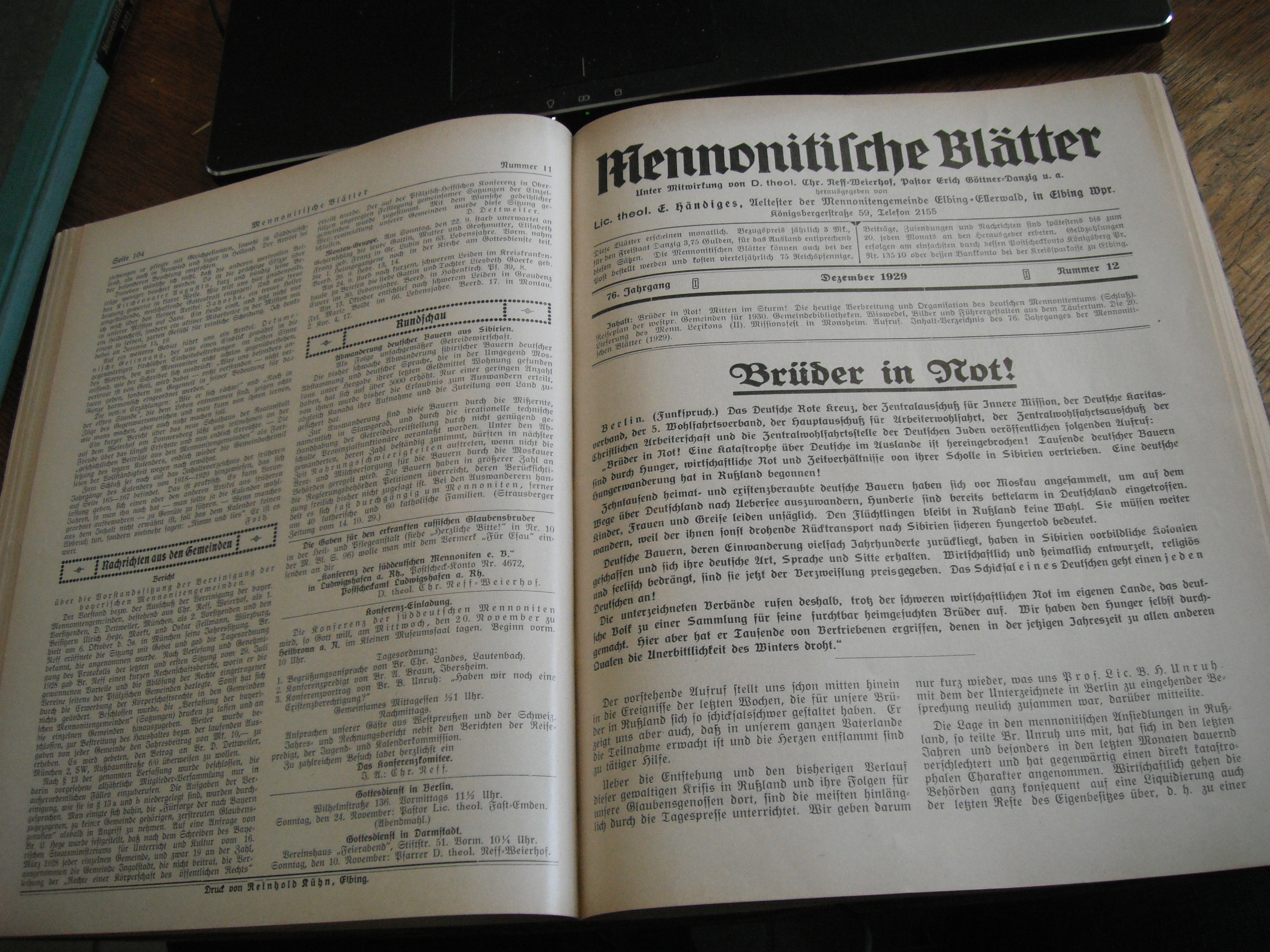
Note 26: “11. November 1929, Drahtbericht, Twardowski an das
Auswärtige Amt,” Deutsche Hilfsmaßnahmen: Dokumente, 6–7; also “13. November
1929, Oskar Trautman an Julius Curtius,” Deutsche Hilfsmaßnahmen: Dokumente,
8–12.
Note 27: “11. November 1929, Twardowski an das Auswärtige
Amt,” Deutsche Hilfsmaßnahmen: Dokumente, 6–7; “11. November 1929,
Drahtbericht, Twardowski an das Auswärtige Amt,” also “13. November 1929, Oskar
Trautman an Julius Curtius,” Reichskanzelei, “Die deutschstämmigen Kolonisten
in Rußland,” Blatt 24 (slide 49).
Note 28: Cf. “Brüder in Not!,” Vossische Zeitung (Berlin),
no. 536 (November 13, 1929), 6; Mennonitische Blätter 76, no. 12 (December
1929), 105 (link).
Note 29: Benjamin H. Unruh to Levi Mumaw, November 14, 1929.
From MCC-A, IX-01-01, box 10, file 210036.
Note 30: B. Unruh, “Bericht III: Zur Massenflucht, November
23, 1929,” 8.
Note 31: B. Unruh, “Bericht III: Zur Massenflucht,” November
23, 1929, 4.
Note 32: “13. November 1929, Trautman an Curtius,” Deutsche
Hilfsmaßnahmen: Dokumente, 8–12.
Note 33: On costs, cf. Curtius to the State Secretary of the
Chancellery, November 6, 1929, in Akten zur deutschen auswärtigen Politik,
Serie B, XIII, 227, no. 104; 228 n.8; budget proposal, Nov 13, 1929,
Reichskanzelei, “Die deutschstämmigen Kolonisten in Rußland,” 135, no. 66.
Note 34: F. Epp, Mennonite Exodus, 239.
Thank you very much for publishing this story, including the video. We must remember these stories. The next generation deserves them because those who do not know the past are condemned to repeat it. Those who do know are better able to discern the present as well as navigate the future.
ReplyDelete